Few players in college football carry the kind of spotlight Arch Manning does. As the heir to football’s most famous family name, every throw, every read, and every game of his sophomore season at Texas has been magnified under a national microscope. Analysts debate his mechanics, fans critique his decision-making, and rivals revel in every interception.
But here’s the truth — Manning’s struggles in 2025 are not just about Manning. They are deeply tied to the circumstances surrounding him: a rebuilt offensive line, a young and inconsistent group of receivers, and an offensive system still trying to find rhythm after major offseason losses. Beneath the surface-level statistics lies a story of a talented quarterback learning the hardest lesson of all — that football is a team sport, and no quarterback, no matter how gifted, can thrive without stability around him.
Protection Problems Are Defining Manning’s Learning Curve
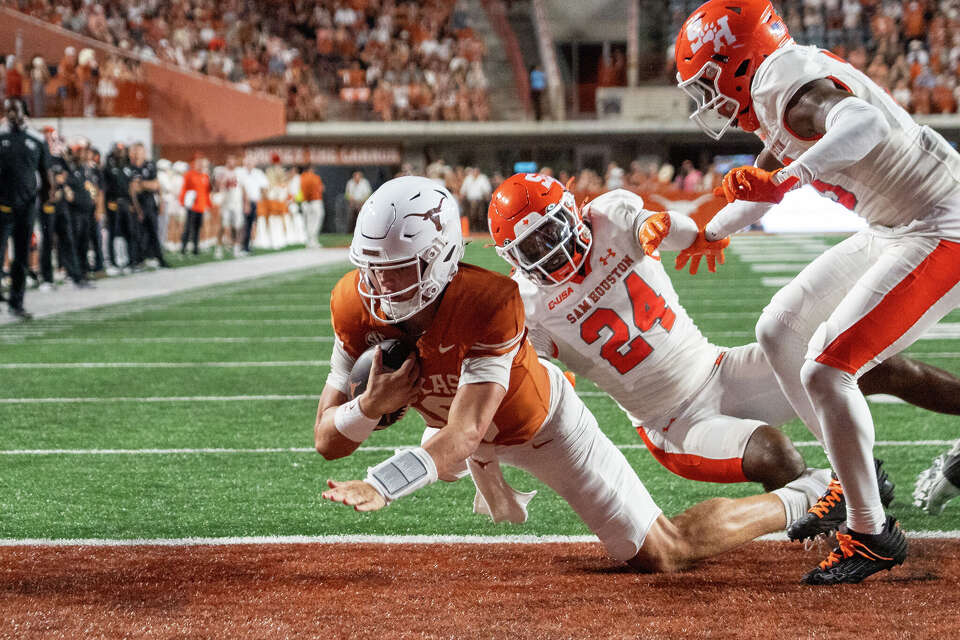
Every great quarterback’s confidence starts with trust — trust that his line will give him time to operate. For Arch Manning, that trust has been shaken from the opening week of the 2025 season.
Through seven games, the numbers paint a telling picture: Manning has been pressured on nearly 40 percent of his dropbacks, one of the highest rates among SEC quarterbacks. That’s a staggering number for any offense, but especially for one that depends so heavily on rhythm and precision like Steve Sarkisian’s system.
The root of the issue lies in personnel turnover. Texas entered 2025 having lost four of its five starting offensive linemen from last year’s playoff team. What was once a strength has become a revolving door of new faces trying to find cohesion. With young, inexperienced blockers learning on the job against elite SEC defensive lines, breakdowns have become inevitable.
The result? Manning’s internal clock has accelerated — and not in a good way.

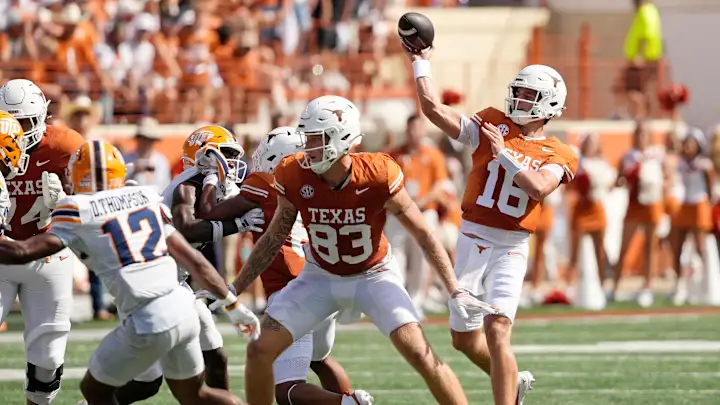
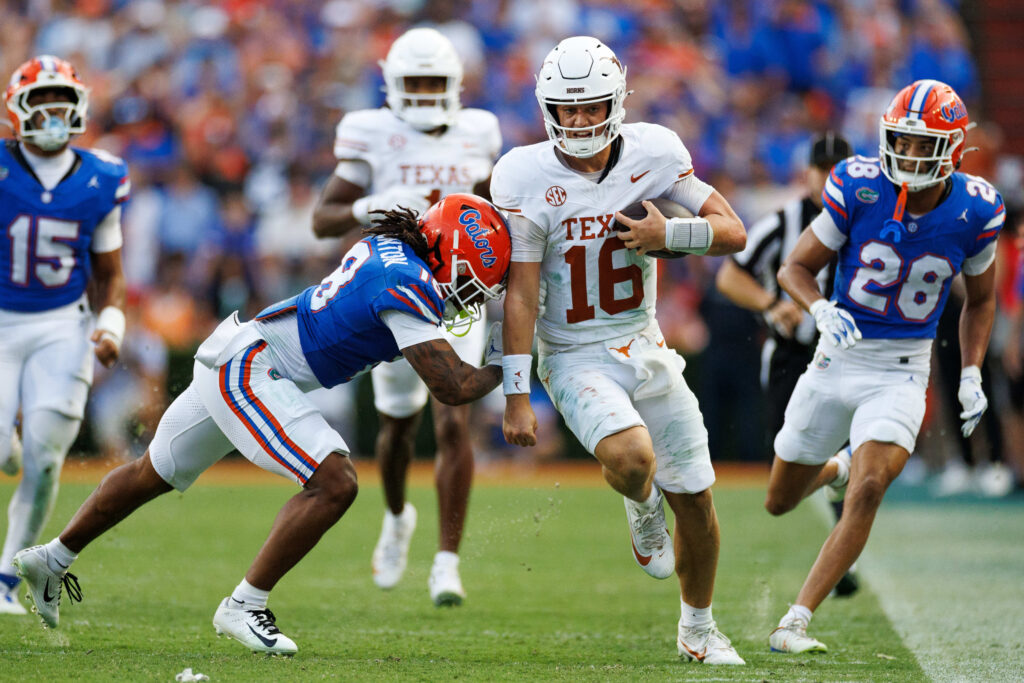
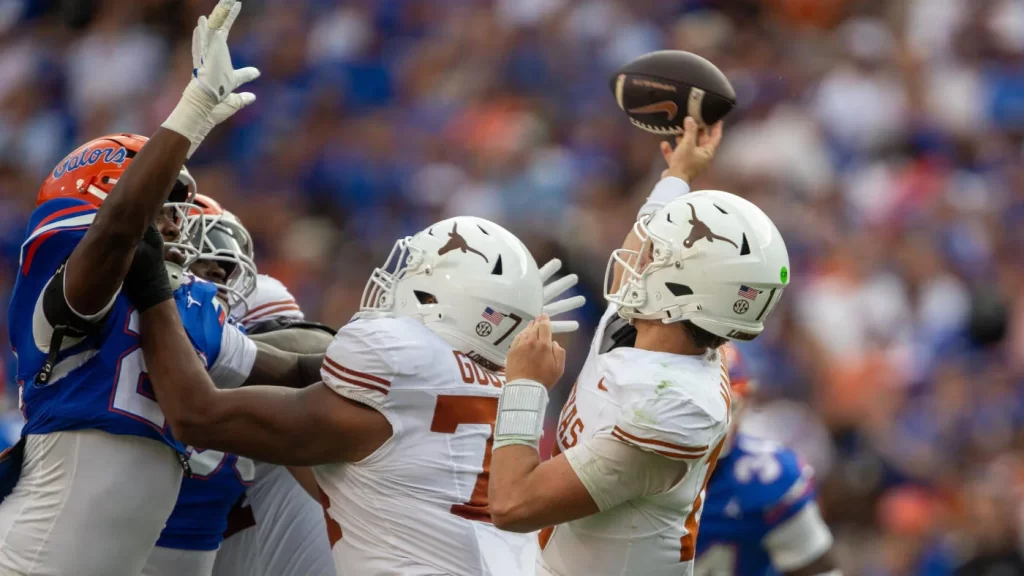
He’s been sacked 13 times, including a bruising six sacks against Florida alone. The constant pressure has forced him to adjust his style of play. Instead of setting his feet and delivering strikes, he’s often drifting backward, improvising on the move, and relying more on athleticism than mechanics. Critics call it “hesitation” or “regression,” but it’s often just self-preservation.
When Manning does get protection, the difference is night and day. In clean-pocket situations, his completion rate jumps to 71 percent, closely resembling the confident, accurate passer who wowed coaches in spring practices. Those glimpses remind fans why he was the top quarterback recruit in his class and a potential future NFL star.
But until the offensive line grows up, those flashes will remain just that — flashes.
A Young Receiving Corps Still Searching for Rhythm
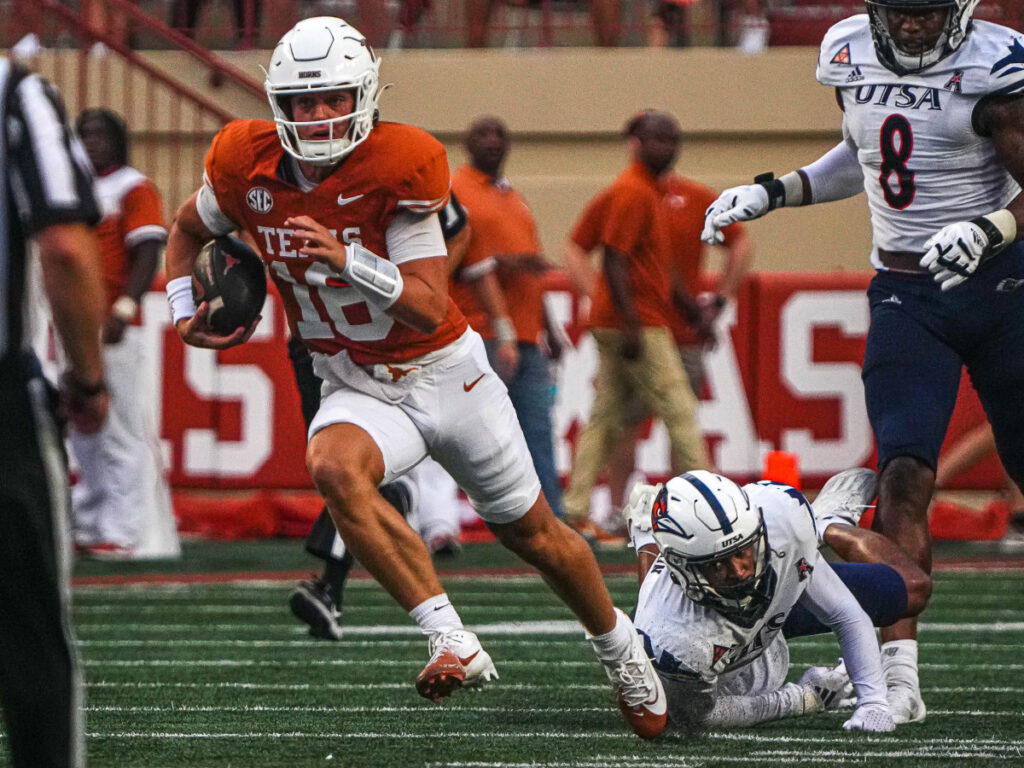
If protection issues are half the story, the other half lies downfield. Texas’ receiving unit is young, talented, and full of promise — but still figuring out how to perform consistently at the SEC level.
Last season, the Longhorns had the luxury of veteran playmakers like Xavier Worthy and Adonai Mitchell, both now in the NFL. Their chemistry with Manning’s predecessor made the 2024 Texas offense hum. But when both left for the pros, they took with them not just production, but experience, timing, and leadership.
That void has forced underclassmen like Johntay Cook, DeAndre Moore Jr., and Ryan Niblett into major roles. Their potential is undeniable — Cook’s speed can stretch any defense, and Moore’s route-running shows polish beyond his years — but potential doesn’t always translate into week-to-week reliability.

The result has been a series of small but costly misfires: missed routes, mistimed cuts, dropped balls, and occasional miscommunications that lead to broken plays. Those moments don’t always show up in stat sheets, but they directly influence public perception. A perfectly timed deep shot can become an “overthrow” if a receiver breaks a step too early. A quick slant becomes an “incompletion” if a receiver hesitates off the line.
For a quarterback like Manning, whose game is built on precision and rhythm, those disruptions are magnified. Each mistake chips away at tempo and confidence, forcing the offense into more conservative play-calling. Instead of pushing the ball downfield as Sarkisian’s system is designed to do, Manning is often limited to short, quick reads — checkdowns and timing routes meant to mask protection breakdowns and avoid turnovers.
It’s not that the offense lacks firepower. It’s simply too young to play freely right now.
Systemic Issues Over Individual Struggles
There’s a reason head coach Steve Sarkisian has publicly stood by Manning despite the scrutiny. Those inside the Texas program understand that this isn’t about one player’s shortcomings — it’s about a unit still trying to synchronize.
Sarkisian’s offense is one of the most complex in college football. It requires pre-snap communication, precise route timing, and trust that everyone — from the quarterback to the right tackle — is seeing the same picture. When that chain of trust breaks at any point, the entire play collapses.
That’s what has been happening in Austin.

The young offensive line has yet to develop consistent communication in blitz recognition. Running backs have missed key pass-protection assignments. Receivers have been late on hot routes. These small, cumulative breakdowns have shaped the perception of Manning’s season more than any single poor throw or turnover.
The quarterback, as always, wears the blame. But in truth, the offense around him is still learning how to protect him — both literally and structurally.
Growth in the Fire
Despite the adversity, there’s an important silver lining: this kind of season can forge long-term success.
Every great quarterback endures a period of growing pains, especially when thrust into leadership of a young offense. Peyton Manning — Arch’s uncle — threw a league-high 28 interceptions his rookie NFL season. Eli Manning endured brutal stretches early in his career behind shaky lines. Both grew stronger for it.
Arch Manning is following a similar path. The constant pressure, the narrow throwing windows, and the scrutiny from fans and media alike are all part of the learning process. The key is how he responds — and by all accounts, he’s handling it like a pro. Coaches have praised his composure, his film-room dedication, and his willingness to take accountability.
More importantly, he hasn’t lost the locker room. His teammates continue to rally behind him, seeing his leadership and determination even as the offense struggles. For a young quarterback, that’s a sign of maturity beyond his years.

Looking Ahead: A Brighter Future
The reality is that Texas’ offensive youth is both its current weakness and its future strength. The same linemen who are missing assignments now will be seasoned, cohesive veterans a year from now. The same receivers who are learning route precision in 2025 will have full seasons of experience by 2026.
When that development catches up with Manning’s natural ability, the Longhorns’ offense could explode back into the national spotlight.
In fact, Texas’ 2025 growing pains look eerily similar to Alabama’s transitional years between Tua Tagovailoa and Bryce Young — a talented team learning through adversity before returning to dominance.
If the offensive line gels and the young receivers continue developing chemistry with their quarterback, Manning could go from “underachieving sophomore” to “Heisman contender” in a single offseason.
The Bottom Line
Arch Manning’s struggles this season aren’t signs of failure — they’re symptoms of transition. A new-look offensive line still searching for identity, a young group of receivers still finding rhythm, and a quarterback adjusting to a faster, more physical SEC landscape.
His numbers may not yet reflect his potential, but the foundation is being built quietly beneath the noise. As Texas fans grow impatient, they should remember that even the most gifted quarterbacks need stability to shine.

For now, the key is patience — because when this unit finally clicks, Arch Manning’s “struggles” will be remembered not as setbacks, but as the necessary growing pains that shaped the Longhorns’ next great era.
In truth, the hidden factor in Arch Manning’s season isn’t his shortcomings — it’s the youth surrounding him, still learning to rise to his level.